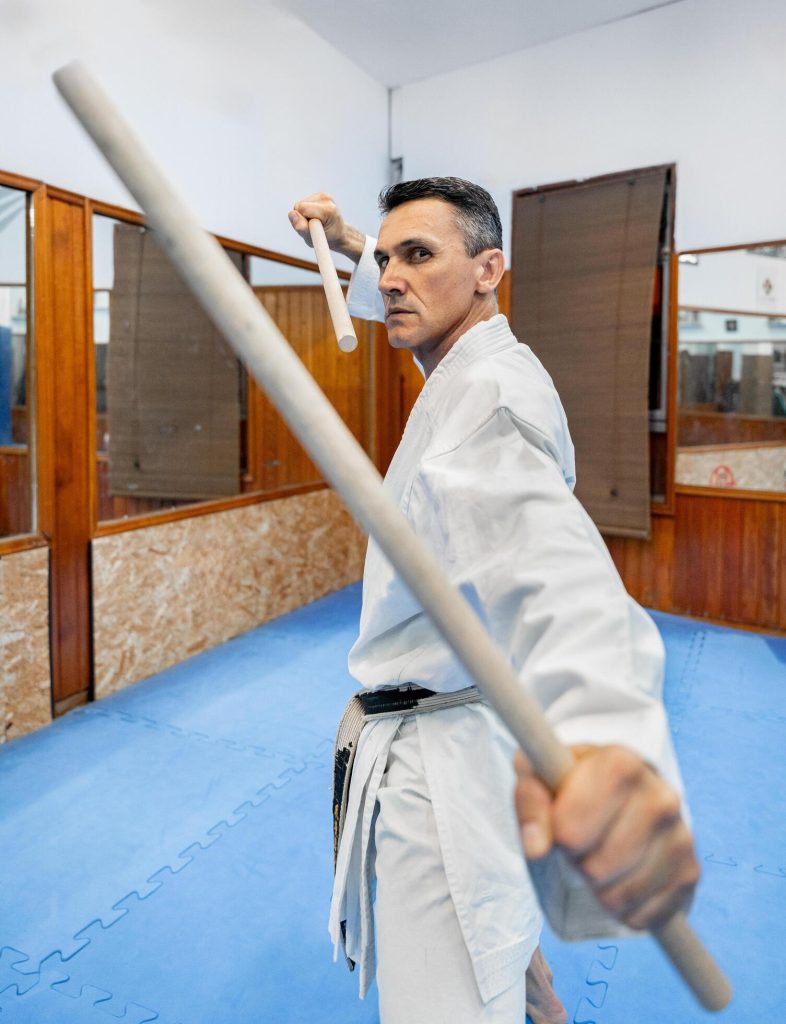
Karate has a weapons side, and it has a name: kobudo. The five you will meet most often are the bo (staff), the sai (three-pronged truncheon), the tonfa (side-handled baton), the nunchaku (two sticks joined by cord) and the kama (short sickle).
If you came here to find out what a sai is, it is the fork-shaped one – and it is not a dagger. More on that below.
What kobudo actually is
Kobudo is the weapons tradition of Okinawa, trained alongside empty-hand karate rather than instead of it. Many clubs teach it as a separate stream with its own kata, and many students never touch it at all. Where it is taught, it usually starts once a student has some grounding – the movements borrow heavily from what the body already knows.
The practical point for a parent: weapons work in a club is kata and drill, done with training weapons. It is a discipline of control, not of combat.
The sai
A sai is a metal baton with two curved side prongs (yoku) near the handle. They are used in pairs.
The single most common misunderstanding is that it is a stabbing weapon. It is blunt. The prongs exist to trap and turn an incoming weapon, and the shaft is used to strike and block. The butt end of the handle is used as much as the point. It is a heavy, technical piece – the weight is the whole reason it takes years to look good.
Sai kata are some of the most recognisable in kobudo, which is part of why the sai is the weapon most people can picture but fewest can name.
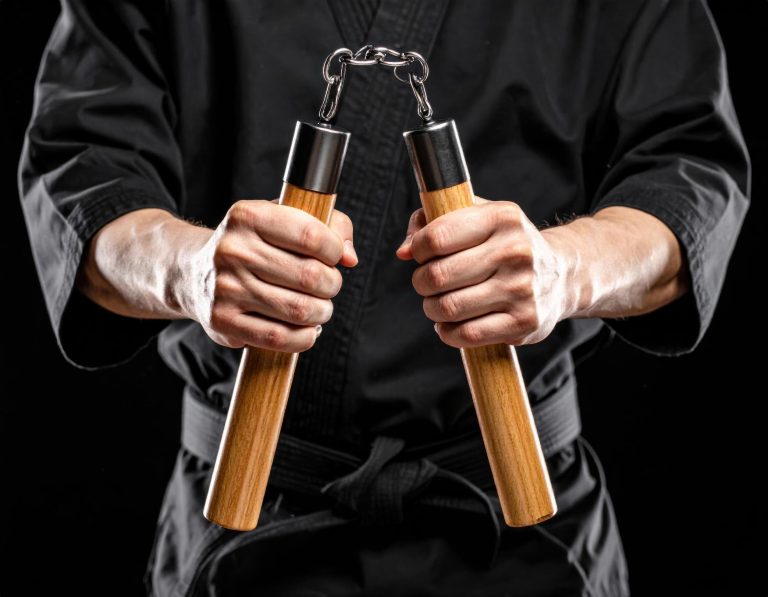
The nunchaku
Two short sticks joined by cord or chain. Traditionally octagonal hardwood, corded rather than chained.
The nunchaku is a flail: it generates speed through the free end, and control comes from stopping it, not swinging it. It is genuinely difficult, it is unforgiving of error, and every honest instructor has hit themselves with one.
Its reputation is a film reputation. Bruce Lee made the nunchaku famous and, in doing so, made it look like a fighting weapon rather than what it is in a dojo – a coordination and timing tool with a demanding kata tradition behind it.
The tonfa
A shaft with a handle set at right angles near one end, used in pairs. Held by the side handle it covers the forearm to block; released and spun, the shaft delivers the strike.
If it looks familiar, that is because it is: the side-handled police baton is a direct descendant of the tonfa, adopted into Western policing in the 1970s. It is the one kobudo weapon that made the jump into everyday equipment.
The bo and the jo
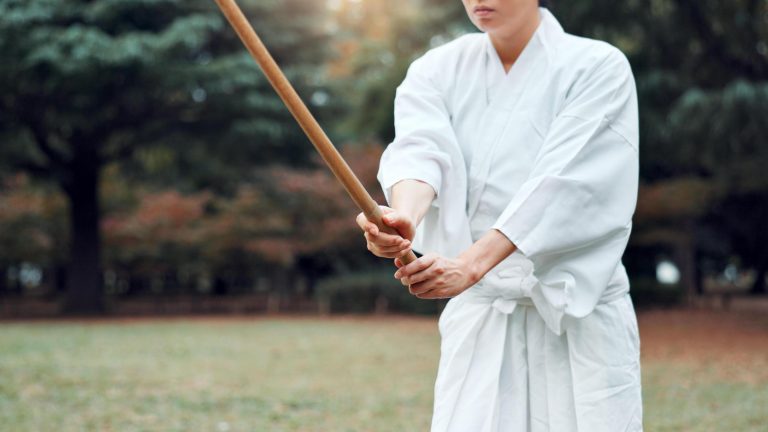
The bo is the long staff – traditionally rokushakubo, about six feet. The jo is the short staff, roughly four feet.
The difference is not just length, it is method. The bo is worked with sliding grips and both ends in play; the jo is closer, quicker, and has its own tradition in jodo and in aikido.
Sizing, roughly: a bo is commonly chosen at about the student’s own height, sometimes a hand-span taller. A jo is often measured to somewhere around hip or armpit height. Styles differ on this and your instructor’s rule wins – ask before you buy, because a staff cannot be shortened by much without ruining its balance.
The kama
A short sickle, used in pairs, with the blade at right angles to the handle. Training versions are blunt or wooden. This one genuinely does come from a farm tool – which brings us to the story everyone repeats.
The farming-tools story is mostly a myth
You will read everywhere that Okinawan peasants, banned from owning weapons, secretly turned their farm implements into a fighting system. It is a wonderful story. The evidence for it is thin.
What historians actually find:
- Some of it is true. The kama really is a sickle. The bo plausibly descends from the tenbin, the shoulder pole used to carry buckets. The eku is straightforwardly a boat oar.
- Some of it is not. Weapons closely resembling the sai and the nunchaku appear in China well before the 1609 invasion of Okinawa. They look far more like purpose-made weapons that
traveled
- , than like tools that were repurposed.
- The ban itself is overstated. What was confiscated was military weaponry – blades and firearms. Blunt implements were largely unaffected, and weapons could be held under permit.
- The likelier route is duller. Upper-class Okinawans
traveled
- to China, learned martial arts there, and brought them home. When that class lost its position under Japanese rule, its members carried on training privately – preserving family knowledge rather than plotting resistance.
Nobles quietly keeping a tradition alive is a less rousing story than farmers outwitting samurai. It has the advantage of being better supported.
What to buy first
Ask your instructor before buying anything. Clubs are specific about what they allow in class, and a weapon bought for the wrong syllabus is money gone.
That said, the usual pattern:
- Foam – for beginners, for children, and for any partner drill. Forgiving of the mistakes everyone makes early on.
- Polypropylene (PP) – the practical everyday choice. Close to the weight and feel of wood, far harder to break, and it survives being dropped on a hard floor.
- Hardwood – for graded students, kata and demonstration. It looks and sounds right, and it will mark if you mistreat it.
A first weapon is usually a bo or a jo, because staff work appears earliest in most syllabuses and the equipment is inexpensive. Sai and nunchaku tend to come later, and both reward buying decent ones once rather than cheap ones twice.
What we stock
We carry bo and jo in foam, polypropylene and hardwood, traditional handmade nunchaku, sai, hardwood and polypropylene tonfa, wooden kama, bokken, shinai, escrima and training blades – at our shop in Hennopspark, Centurion, and by courier nationwide.
Not sure which length your club uses, or whether your syllabus wants wood or polypropylene? Ask us – we would rather answer a question than process a return.
Training weapons are sold as martial arts equipment for supervised instruction in a club setting. Practice under a qualified instructor. Requirements differ between styles and associations – your own instructor’s syllabus is always the authority.