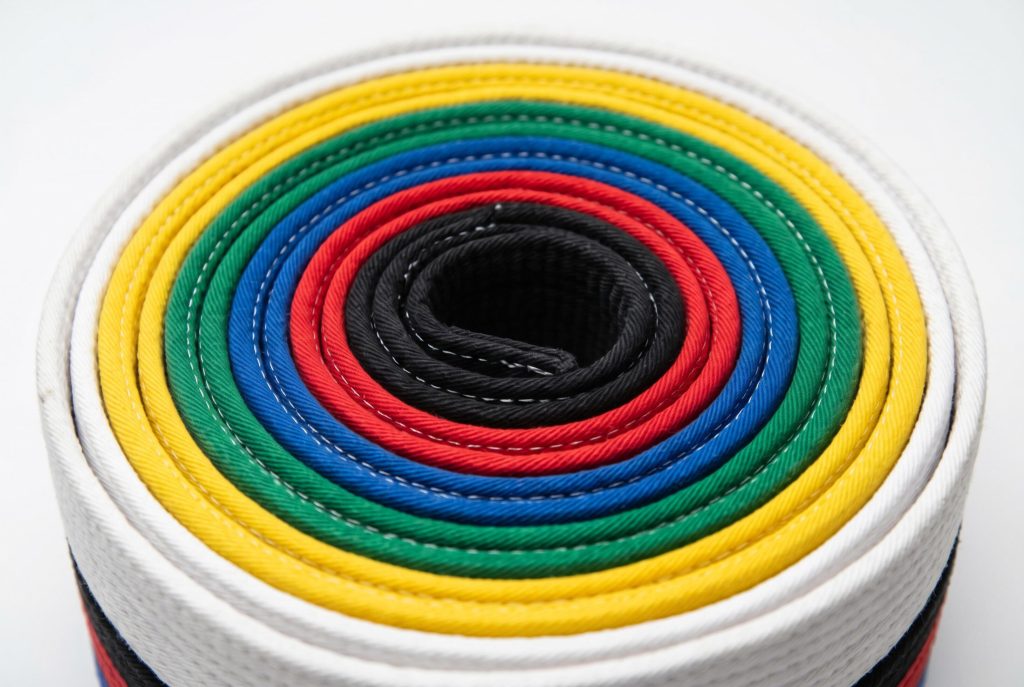
The order most South African karate clubs use is:
white, yellow, orange, green, blue, purple, red (with some styles), brown, black. Some clubs add a striped belt between grades, and a few change the order entirely. If you only came here for that line, you have it.
The rest of this page is for the part nobody tells you: why your club’s
order might not match the one above, how long each belt actually takes, and how to
pick the right belt when you buy one.
There is no universal karate belt order
This is the single most useful thing to know, and most articles skip it. Karate
is not one organisation. Different styles, federations and individual dojos set
their own grading syllabus, and all of them are legitimate. A green belt in one club
may sit above blue; in the club down the road it sits below.
Your instructor’s syllabus is the one that counts. If this page
and your dojo disagree, your dojo is right. Buy the belt your club grades you to,
not the one an article on the internet says comes next.
Kyu and dan: the two halves of the system
Every coloured belt is a kyu grade, and kyu numbers count
down. A beginner might start at 10th kyu or 9th kyu and work towards 1st
kyu, which is usually the last brown belt before black.
Black belts are dan grades, and dan numbers count up.
1st dan (shodan) is the first black belt, and the grades continue upward from there
over decades.
So a student’s whole career runs 9th kyu → 1st kyu → 1st dan →
2nd dan and onward. The count reverses at black belt because reaching black is not
the end of the syllabus. It is the point at which the real syllabus starts.
How the main styles differ
These are the patterns you will most commonly see. Treat them as a guide to what
exists, not as a rule any particular club follows – organisations within the same
style vary, and many clubs have adjusted their own over the years.
| Style | Typical progression |
|---|---|
| Shotokan | White → yellow → orange → green → purple → brown (usually three levels) → black. Purple is sometimes omitted entirely. |
| Wado-Ryu | Similar shape to Shotokan, but blue usually appears before purple, and the brown grades are separated by stripes rather than by shade. |
| Shito-Ryu | Often starts with a white belt carrying a coloured tip, and commonly keeps both blue and purple as separate grades. |
| Goju-Ryu | Frequently uses fewer colours with a tab or stripe marking the halfway point of each grade. Some organisations place blue early, before yellow. |
| Kyokushin | Uses stripes systematically – each colour has a plain version and a striped version, so one colour covers two grades. |
The pattern worth noticing: the more grades a club uses, the more often
its students test. That is not a criticism. Regular gradings keep beginners
and children motivated, and a syllabus broken into smaller steps is easier to learn.
It does mean belt count is a poor way to compare two clubs.
How long does each belt take?
For an adult training two to three times a week, the usual answer is
three to five years from white belt to black belt. Individual
grades run roughly three to six months at the lower end, stretching to a year or
more at brown belt and above.
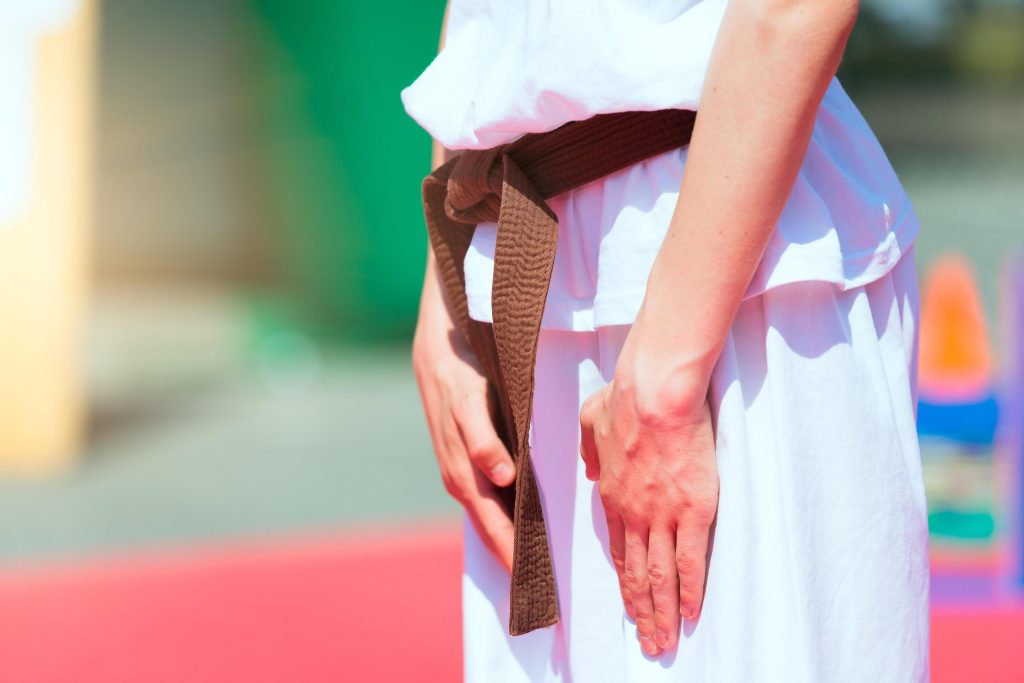
Children usually take longer – five to eight years is normal – not because they
learn more slowly, but because the syllabus asks for a physical maturity that arrives
with time, and most clubs set a minimum age for black belt regardless of ability.
Two honest caveats. Attendance matters far more than talent at the lower grades:
a student who trains twice a week will grade roughly twice as often as one who trains
once. And any club advertising a guaranteed black belt in a fixed number of months is
selling a timetable, not a standard.
What the colours mean
You will often read that the belt colours represent a seed germinating in darkness,
growing towards sunlight, and finally ripening. It is a lovely story and it is
modern – a teaching device added long after the belts themselves,
not an ancient tradition.
The actual history is shorter and more practical. The coloured belt system came
from judo, not karate: Jigoro Kano introduced ranked belts in the
late 1880s, and karate adopted the idea in the twentieth century. Coloured kyu belts
spread later still, largely to give students visible milestones on a long road.
And the story that a black belt is a white belt slowly stained by years of
training? Not true. Belts were never meant to go undyed and unwashed.
The legend is thought to come from wartime rationing, when belts were re-dyed darker
to save on new cloth rather than replaced.
None of this makes the belt mean less. It just means the meaning comes from what
you did to earn it, rather than from a colour chart.
Competition: two federations, two different rules
This is where people get caught out, and it has nothing to do with what you have graded to. If your child competes, read this part twice.
WKF – the belt colour does not matter at all
In WKF-style kumite your grade is irrelevant to what you wear. The two competitors are identified as aka (red) and ao (blue), and each wears a competition belt in that colour over their gi. A brown belt and a black belt in the same bout both wear red or blue, and neither wears their grading belt.
So a WKF competitor needs their grading belt and a red-and-blue competition set. The competition pair is equipment, not rank.
WUKF – competitors are grouped by belt, and the groups are named by kyu
WUKF does the opposite. It divides competitors into groups by grade, and names each group by its kyu rather than by the colour alone:
| Kyu | Belt |
|---|---|
| 9th kyu | White |
| 8th kyu | Yellow |
| 7th kyu | Orange |
| 6th kyu | Green |
| 5th kyu | Blue |
| 4th kyu | Purple |
| 3rd kyu | Brown 1 |
| 2nd kyu | Brown 2 |
| 1st kyu | Brown 3 |
| 1st dan | Black (shodan) |
And what they actually wear depends on the event:
In kata, WUKF competitors wear their own grading belt. The belt you have earned is the belt you compete in, so it needs to be the correct one and it needs to look the part.
In kumite, they wear white and red to tell the two competitors apart – not the red and blue used under WKF rules. This is the single most expensive detail on this page to get wrong: blue equipment has no place at a WUKF event. If you are kitting out for WUKF, buy white and red.
The practical difference is significant. Under WKF the belt tells you nothing about who you are fighting. Under WUKF the belt is the division – so it has to be the correct one for the grade actually held, and it has to be on the day.
The two are not interchangeable
WKF and WUKF are separate federations with separate equipment rules. WUKF domestic competition in South Africa has its own requirements on colour, and entry to a WUKF World Championship requires equipment carrying WUKF’s own approval – WKF approval does not substitute for it, however similar the item looks.
If you are buying for a specific tournament, confirm which federation is running it before you spend the money. We would rather talk you out of the wrong belt than sell you one.
See our WKF competition belts.
Choosing and sizing a belt
Belts are sold by length, not by clothing size, and the numbering runs from about
size 00 (roughly 120 cm) up to size 7 (roughly 200 cm).
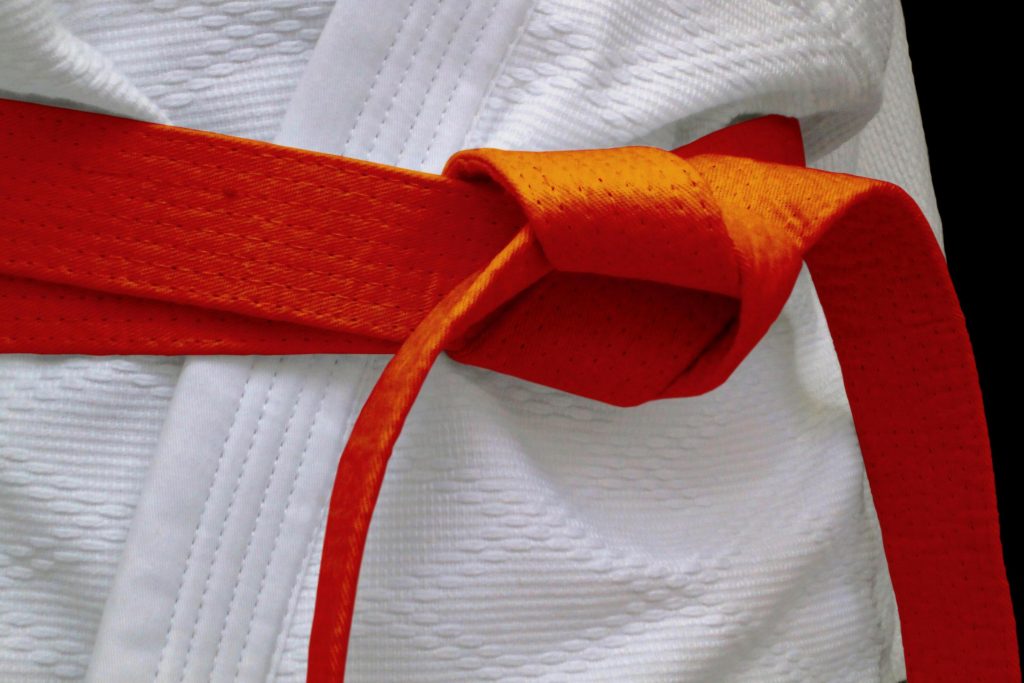
The rule of thumb: the belt should wrap twice around your waist and leave two
ends hanging roughly to the middle of your thigh once tied. Too long is a nuisance
and a trip hazard for children; too short and the knot will not sit. If a student is
between sizes and still growing, size up – the ends shorten as they grow into it.
Some practical notes:
- Lightweight belts tie easily and suit beginners and children.
They are the belts most clubs grade with. - Heavyweight belts hold a knot better and last longer, which is
why black belts are commonly bought heavyweight – it is a belt you may wear for
years. - Embroidery on a black belt takes extra time to produce, so
order well ahead of a grading rather than the week before. - A striped or tipped belt is club-specific. Check the exact
stripe your syllabus requires before ordering.
Full sizing tables are on our size guide.
Buying a belt
We stock lightweight coloured belts across the grading range, competition belts,
and heavyweight black belts, at our shop in Hennopspark, Centurion and by courier
nationwide.
Browse karate belts ·
Black belts
Not sure which grade belt your club uses, or which length to order for a child?
Ask us – we would rather answer a question than process
a return.
Belt orders and grading requirements vary between styles,
federations and individual dojos. This page describes the patterns most commonly seen
in South African karate; your own instructor’s syllabus is always the authority for
your grading.