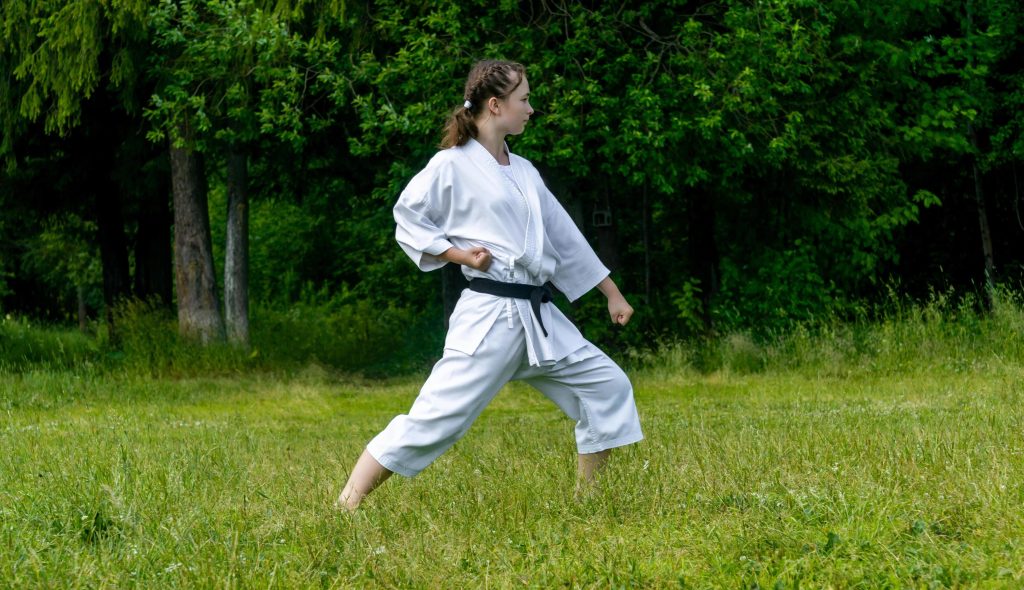
Two questions decide which karate suit you need, and neither is about price: do you compete, and if so, in kata or kumite? Everything else follows from those two answers.
If you are buying a first gi for a child who started last month, skip to the bottom.
Lightweight or heavyweight: it is about kata and kumite
This is the distinction people get wrong most often. A heavyweight gi is not simply a better gi. The two weights do different jobs.
Lightweight suits are for kumite. Sparring rewards speed and free movement, so a kumite gi is cut light and airy, often with mesh panels and full gussets so the legs can kick without the fabric fighting back. It moves when you move.
Heavyweight suits are for kata. Kata is judged on how the technique looks and sounds. Heavier fabric holds its shape, and it produces the sharp snap at the end of a technique that a light gi simply cannot make. It is a performance garment.
Fabric weight is usually quoted in ounces, and most karate gis sit somewhere between 8oz and 12oz. Lighter is cooler, cheaper and wears out sooner. Heavier lasts longer, looks crisper and is warm work in a Gauteng summer.
For a beginner, none of this matters yet. A student who is not competing should buy light and inexpensive, and buy again in a year when they know whether they prefer kata or kumite – and when they have stopped growing quite so fast.
WKF approved, WUKF approved, or neither
An “approved” gi is one a federation has certified for its own competitions. It carries that federation’s label, and it costs more because of the certification, not because the cotton is different.
You only need one if you are competing at that federation’s events. A club student, a grading candidate, and anyone competing at a local open does not need an approved gi and should not be sold one.
The two are not interchangeable – the same point as with belts. A WKF-approved suit is not accepted as WUKF-approved, and the reverse is equally true. If you are buying for a specific championship, establish which federation sanctions it before you spend the money. The label on the gi has to match the body running the event.
Fitting rules for competition: WKF vs WUKF
Both federations publish exact fit rules, and most of it matches – but not all of it. Here is what each currently says (WKF Kata and Kumite Competition Rules, valid from 1 January 2026; WUKF Competition Rules – General Karate, Version 28, 26 April 2024):
| Rule | WKF | WUKF |
|---|---|---|
| Sleeves | No longer than the bend of the wrist, no shorter than halfway down the forearm. Not rolled up. | Same: must reach halfway down the forearm, no longer than the bend of the wrist. Not rolled up. |
| Trousers | Must cover at least two-thirds of the shin, must not reach below the anklebone. Not rolled up. | Same: must cover two-thirds of the shin, must not reach the anklebone. Not rolled up. |
| Jacket length | Covers the hips when tightened with the belt; no longer than three-quarters thigh length. | Covers the hips when tightened with the belt; must not reach the knees – a different cap, worded differently from WKF’s. |
| Competition belt length | ~5cm wide, 15cm free each side of the knot, not longer than three-quarters thigh length. | 15-30cm free each side of the knot (a range, not a fixed figure), must not reach the knees. |
| Belt worn in KATA | The allocated red (AKA) or blue (AO) competition belt – your grading belt may not be worn. | The opposite: wear your own grade belt. A red/white identification belt only replaces it if the event uses flag judging rather than electronic scoring. |
| Embroidery / stripes | Not allowed beyond the approved manufacturer/brand spaces – no stripes, piping or personal embroidery. | Allowed – stripes and the manufacturer’s name may be embroidered on the gi. |
| Religious headwear | A black plain fabric head scarf, WKF-approved, covering the hair but not the neck or throat. | A white scarf or chador for Muslim women. |
| Karategi alteration | Explicitly stated: must not be altered or manipulated to change its shape. | Not stated in the general rulebook we have on file – absence here isn’t confirmation WUKF allows it, just that we haven’t seen it written down. |
The practical takeaway: don’t assume a suit or belt that’s correct for one federation is correct for the other. Sleeves and trousers happen to match, but jacket length, belt length, the kata belt colour, and embroidery genuinely differ. A gi decorated to WUKF’s rule (stripes, manufacturer’s name) could fail a WKF inspection. If you are buying for a specific competition, establish which federation sanctions it before you spend the money, and check with your coach which ruleset applies.
Federation rules are updated periodically, so treat this table as a snapshot of each federation’s current rulebook rather than a permanent reference, and confirm the current version before a first competition.
White or black
Karate competition is white. If there is any chance of competing under WKF or WUKF rules, buy white. A black gi will not get you onto the mat.
Black has its place – it is worn in some styles, it is common for weapons and kobudo work, plenty of instructors prefer it, and it hides a training-hall floor far better than white does. It is a training and style choice, not a competition option.
Check with your instructor before buying black. Some clubs require white for every class; others do not mind. It is a cheap question and an expensive assumption.
What to buy, by stage
- Starting out, or a growing child – a lightweight twill suit. Inexpensive, easy to wash, easy to replace. Nobody’s first gi should be an investment.
- Training regularly, not competing – a heavyweight suit. It survives several years of washing, and it looks and feels like a serious gi.
- Competing in kumite – a lightweight competition suit, approved for whichever federation you compete under.
- Competing in kata – a heavyweight kata suit, again matched to the federation. This is where the fabric genuinely changes how the performance reads.
- Instructors and weapons work – whatever you like, within your association’s rules. This is where black earns its keep.
What we stock
We carry the full ladder – lightweight twill suits for beginners, black lightweight suits, heavyweight suits for daily training and grading, WKF-approved lightweight kumite and heavyweight kata suits, and WUKF-approved suits – at our shop in Hennopspark, Centurion, and by courier nationwide.
Sizing is its own subject and we will cover it properly in a separate guide. In the meantime the tables on our size guide will get you close, and if a student is between sizes and still growing, size up.
Not sure whether your association wants WKF or WUKF, or whether your club allows black? Ask us – we would rather answer a question than process a return.
Competition equipment rules differ between federations and are updated from time to time. Your own instructor and the association running your event are always the authority on what is permitted.